 English
 Русский
 Română
Walk any serious spirits aisle and you will meet the same puzzle in three bottles: a French cognac, a Moldovan divin and something labelled simply "brandy". All three are distilled from grape wine. All three rest in oak. All three borrow the same alphabet of VS, VSOP and XO. Yet one commands luxury prices, one is protected by European law but barely known in the West, and one is a catch-all that spans everything from supermarket blends to old Armagnac's cousins. This guide untangles the three - for the sommelier building a list, the distributor weighing an allocation, and the enthusiast who simply wants to know what is in the glass.
The short answer
- Brandy is the family: any spirit distilled from fermented fruit - in practice, usually grapes - aged briefly in oak and bottled at 36-40% ABV or more.
- Cognac is the family's most famous aristocrat: a tightly regulated French appellation (AOC), made only in the Charente region, from prescribed grapes, twice distilled in copper pot stills.
- Divin is Moldova's own protected grape brandy: made by essentially the same philosophy as cognac, with longer minimum ageing in the senior tiers, explicit age statements cognac rarely prints - and prices that undercut comparable French XO by an order of magnitude.
One family, three names
Begin with the genus. The word brandy descends from the Dutch brandewijn - "burnt wine" - and describes any spirit distilled from the fermented juice or wine of fruit. In the European Union, a spirit labelled simply "brandy" must be made from grape wine and aged at least six months in oak; in the United States the standard of identity requires distillation below 95% ABV and bottling at no less than 40%. Everything else - fruit brandy, pomace brandy, grappa, Calvados - is a qualifier on that stem.
Cognac and divin are two of the family's most refined species, and they are more alike than either marketing department might admit. Both begin with a deliberately poor drinking wine: thin, sharply acidic, low in alcohol. Both are distilled to concentrate aroma, matured in oak for years or decades, and bottled at a minimum of 40% ABV. Both use the same European ladder of VS, VSOP, XO and XXO. Strip away the label and the two share a near-identical production philosophy. What divides them is geography, law and - decisively - what the market will pay.
Where the law draws the line
Cognac is an Appellation d'Origine Contrôlée, formalised by the French law of 1 May 1909 and policed since 1946 by the Bureau National Interprofessionnel du Cognac (BNIC). It may only be produced in the Charente and Charente-Maritime departments (plus slivers of Deux-Sèvres and Dordogne), across roughly 79,000 hectares of vineyard divided into six crus - from the chalky, long-ageing Grande Champagne to the maritime Bois Ordinaires. The "Champagne" in those cru names refers to the open chalk plain of old French, not the sparkling-wine region.
Divin exists, quite literally, because of intellectual-property law. Throughout the Soviet era, Moldovan grape brandy was sold across the USSR as "cognac". After independence, that name was no longer defensible internationally, so Moldovan academics coined a new one from distilat de vin - "wine distillate" - arriving at divin, a word that also happens to mean "divine" in Romanian. Divin became Moldova's legal term in 1993; its technical specification (the Caiet de Sarcini) was approved in 2012, and the geographical indication has been protected across the EU since 18 October 2016 under the EU-Moldova Association Agreement. Unlike cognac's tight zone, the Divin indication covers the entire territory of Moldova - a country whose 300-plus sunny days a year and temperate climate sit on the same latitudes as Burgundy.
Brandy, unqualified, is simply a generic class. It can be made anywhere on earth, to widely varying standards - which is precisely why the protected names matter.
| Parameter | Cognac | Divin | Brandy (general) |
|---|---|---|---|
| Origin | Charente / Charente-Maritime, France | Anywhere in Moldova | Anywhere |
| Legal status | French AOC / EU GI | Moldovan PGI, EU-protected since 2016 | Generic class |
| Main grapes | Ugni Blanc (~98%), Folle Blanche, Colombard | Aligoté, Rkatsiteli, Fetească Albă, Ugni Blanc, Riesling and local crossings | Any grapes (or other fruit) |
| Stills | Charentais pot still, double distillation only | Continuous, direct or double; copper contact required | Varies |
| Collection strength | Up to ~72% ABV | 62-72% ABV | Varies |
| Oak | French (Limousin / Tronçais) | Primarily Moldovan and Caucasian oak | Varies |
| Minimum ageing | 2 years (VS) | 3 years (VS) | 6 months (EU) |
| Minimum bottling | 40% ABV | 40% ABV | 36-40% ABV by market |
The grapes: one-variety purity versus an Eastern palette
Cognac is overwhelmingly a one-grape story. Ugni Blanc - the Italian Trebbiano, known locally as Saint-Émilion - accounts for around 98% of the region's vines, prized precisely because it yields a thin, tart wine unsuitable for drinking but ideal for the still. Folle Blanche and Colombard make up most of the remainder.
Divin draws on a broader, more Eastern European palette: Aligoté, the Georgian workhorse Rkatsiteli, the indigenous Fetească Albă, alongside Ugni Blanc, Colombard, Riesling, Chardonnay, Sauvignon and local crossings such as Alb de Onițcani and Alb de Suruceni. This is a genuine point of difference in the glass. Divin blends routinely marry French varieties with indigenous and Caucasian grapes, lending a floral, patisserie-scented signature that a pure Ugni Blanc spirit does not have.
In the still: rigid tradition versus regulated flexibility
Both traditions start from base wine made without added sulphur dioxide and without chaptalisation. The sulphur rule is worth pausing on, because it is one of the best technical talking points in the category: residual SO2, heated in a copper still, can be reduced into volatile sulphur compounds - hydrogen sulphide and ethyl mercaptan - which read as burnt rubber or struck match even at microscopic concentrations. Banning it across the entire base-wine cycle forces immaculate cellar hygiene and swift processing, and rewards the drinker with unblemished fruit purity.
From there the two regimes diverge. Cognac must be twice distilled in the Charentais copper alembic, whose very dimensions are legally controlled: a first pass yields the cloudy brouillis at roughly 28-32% ABV, and the second - the bonne chauffe - is where the distiller makes la coupe, keeping only the heart of the run, collected up to about 72% ABV. Everything must be finished by 31 March following the harvest.
Divin's specification is more permissive on hardware: continuous, direct or double distillation are all allowed, provided the surfaces in contact with hot wine or vapour include copper, with the young distillate collected at 62-72% ABV. In regulatory spirit this places divin closer to Armagnac than to cognac's pot-still-only rule - though many premium divins, including the Akademos expressions, are in fact made by classic double distillation in Charentais-type stills.
Time in oak: where the real character is made
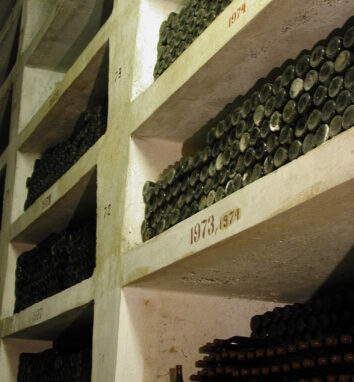
Ask any cellar master and they will tell you the still makes the spirit, but the barrel makes the brandy. Cognac ages exclusively in French oak from the Limousin and Tronçais forests, in casks of roughly 340-400 litres. Each year, 2-3% of every barrel evaporates - the poetic part des anges, the angels' share - and very old eaux-de-vie are eventually moved to glass demijohns to halt their development.
Divin must age a minimum of three years, primarily in Moldovan and Caucasian oak, in barrels of some 300-500 litres - a wood that gives a smoother, less aggressively tannic structure than young French oak. For the senior XO and XXO tiers, the rules permit gradual in-barrel dilution of no more than 5% ABV per year down to a floor of 55%, followed by mandatory "marrying" rests after blending: up to a full year for the oldest categories. It is a slow, deliberate integration of water and spirit that avoids the chemical shock of rapid proofing before bottling.
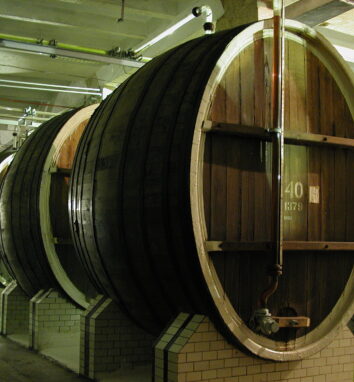
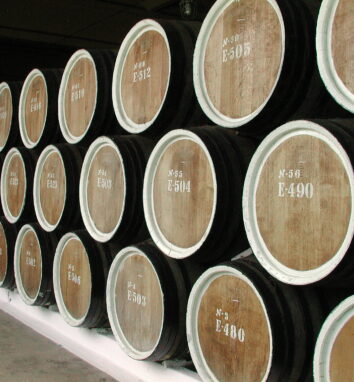
Here lies one genuinely Moldovan wrinkle with no equivalent in the Charente. Vinăria Ialoveni is Moldova's only producer of pelicular wines - wines aged under a living veil of yeast in a criaderas-and-solera system, closely related to Spanish sherry. The casks that once held those Oloroso-style wines are then used to mature the house's oldest divins. Akademos 25 Years and Ambassador 30 Years both rest in secular oak seasoned this way - the same principle that makes ex-sherry casks the most prized wood in Scotch whisky, and an approach that recalls Brandy de Jerez far more than cognac.
Reading the label: the age ladders compared
The three-letter vocabulary is shared, but the numbers behind it are not. Cognac's ladder is defined by the youngest eau-de-vie in the blend; divin's minimums run longer in the senior tiers.
| Tier | Cognac minimum | Divin minimum |
|---|---|---|
| VS | 2 years | 3 years |
| VSOP | 4 years | 5 years |
| Napoléon | 6 years | - |
| XO | 10 years | 7 years |
| XXO | 14 years | 20 years |
Moldova also retains a traditional ladder from an older era, still respected by the trade on domestic labels: DVM (matured, 6-7 years), DVS (superior, 8-9 years), DVV (old, 10-19 years) and DVFV (very old, 20 years and beyond), plus "collection" divins with extended additional ageing.
The practical difference for buyers is this: because cognac's official scale stops at XXO, precise age statements - 25 years, 30 years - are rare on French labels. Moldovan producers print them routinely. A bottle that states its decades plainly is easier to sell, easier to explain at the table, and easier to benchmark on price.
Divin offers XO-and-older maturity, explicit age statements and competition-medal credibility - in a market conditioned to associate those cues with far higher prices.
How they taste
A young cognac (VS or VSOP) is bright and fruity: pressed grape, apricot, vine flower, vanilla and light oak. With roughly a decade in wood comes the prized rancio charentais - an oxidative, nutty, walnut-oil-and-mushroom complexity that deepens for decades alongside candied fruit, leather, tobacco and spice.
Divin follows a parallel arc with its own accent. Young divins lean floral and patisserie-like, with fresh white fruit; extended ageing brings dried fruit, honey, chocolate, noble oak and balsamic depth. In the Ialoveni expressions the sherry-seasoned wood adds a further register:
- Akademos 25 Years (created for the 70th anniversary of Moldova's Academy of Sciences; gold medallist at the DB&SB Brandy Masters 2021 in the UK): amber to mahogany, with roasted walnut and hazelnut, honey, dried fruit, coffee and a gently bitter-spicy, wood-framed finish.
- Ambassador 30 Years: deeper and darker - toasted almond, pipe tobacco and dried black plum on the nose, then warm caramel, vanilla pod, dark chocolate and dried stone fruit, carried on the smooth, oxidative richness that only sherry-seasoned casks impart.
The wider brandy family, briefly
Context helps when you are positioning any of these on a list. Armagnac is France's other great grape brandy - usually single-distilled in a column still, rustic, powerful and often vintage-dated. Brandy de Jerez, from Andalusia's Sherry Triangle, ages dynamically through the criaderas-and-solera system in sherry-seasoned American oak - darker, sweeter, more oxidative, and the closest stylistic relative of Ialoveni's cask philosophy. Pisco is unaged or lightly aged, floral, built for cocktails. Armenian and Georgian brandies share divin's Black Sea heritage and its Soviet-era history of being sold as "cognac". Calvados, kirsch, slivovitz and grappa are the family's fruit-and-pomace cousins rather than grape brandy proper.
Why buyers are looking east
The commercial backdrop makes this comparison more than academic. Cognac - a roughly three-billion-euro export business - is enduring a genuine demand crisis: according to the BNIC, global shipments fell 15.1% in 2025 to 141 million bottles, with value down 25.3%, squeezed simultaneously by a 32.2% Chinese anti-dumping duty and 15% US tariffs that pushed American retail prices up by around a third. Cognac's two largest markets were hit at once.
Moldova's divin, by contrast, is a small but fast-growing category riding a premiumisation wave: per Moldova's National Bureau of Vine and Wine, divins and distillates earned around $51 million in exports in 2023 - up 75% year on year - representing 26% of the country's wine-sector export value from just 11% of its volume.
On quality-to-price, aged divin is arguably the best value in the grape-brandy world. A serious ten-year divin sells where entry-level VSOP cognac sits; a 25 or 30-year expression trades at a low three-figure price - a fraction of comparably aged cognac, when the French houses print such ages at all. For distributors, that gap is the opportunity. For sommeliers, it is a by-the-glass margin story. For collectors, it is a value window that has not yet closed.
Serving and assessing, whatever the label says
- Glassware: the tulip has displaced the balloon snifter among professionals - its narrower rim channels aroma without letting alcohol vapour overwhelm the delicate notes. Pour 20-30 ml.
- Temperature: serve neat at 18-22°C; cold suppresses aroma, and the warmth of the palm gently opens older spirits.
- Water and ice: a drop of water can open the glass; ice is fine with a young VS or VSOP, but leave the XO-and-older bottles alone.
- Pairing: dark chocolate, hard and blue cheeses, roasted nuts, dried fruit and a good cigar suit both cognac and aged divin. Ialoveni recommends Akademos with cheese, lean meats and olives.
- The blind pour: the fastest way to make the case at the table - pour an aged divin blind against a cognac XO and let the rancio speak for itself.
- Buyer's questions: ask for the youngest age in the blend, the still type, cask origin, and whether sugar, caramel or oak infusion were used. Both traditions permit them within limits; good producers will answer plainly.
The verdict
Strip away the marketing and the three names converge on one great idea: thin white wine, patient distillation, decades of oak. Brandy is the family. Cognac is its most celebrated - and currently most expensive - estate. Divin is the relation who learned the same craft, in the same kinds of stills, on gentler land further east, and who will still show you a 25-year age statement for the price of a French VSOP flight. For anyone who buys, sells or simply loves aged grape spirit, that is not a footnote. It is the story.
Taste the argument
Akademos 25 Years and Ambassador 30 Years - ultra-aged Divin (PGI, XXO tier) from Vinăria Ialoveni, matured in sherry-seasoned secular oak and reserved for international distribution.
Explore the Collection Become a DistributorMarket figures cited are producer- and industry-reported (BNIC; Moldova's National Bureau of Vine and Wine) as at their respective publication dates and may have since been revised. Neither cognac nor divin producers are required to declare permitted additives on the label; details of specific bottlings rest on producer disclosure. Enjoy responsibly.